Last Updated on June 5, 2026 by Prabhakar A
If you’ve ever tracked a package and watched it sit in “in transit” limbo for three days, you already understand the problem. The data exists somewhere. But the systems holding that data aren’t talking to each other.
That’s not just a customer experience issue. For logistics companies, it’s a revenue problem, an operational problem, and increasingly, a competitive survival problem.
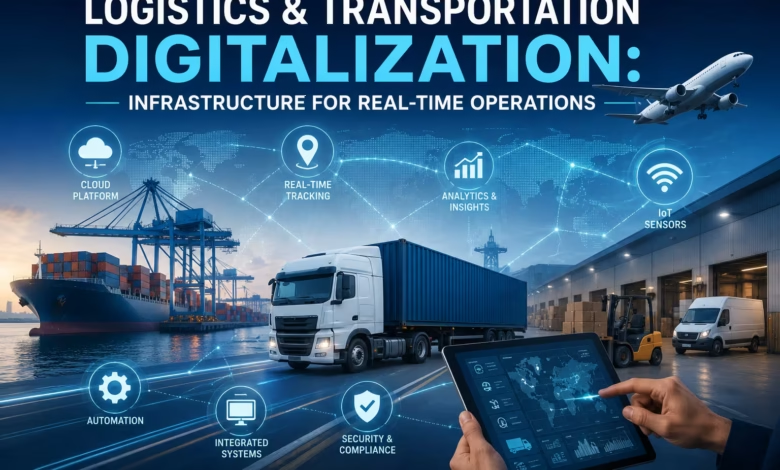
Digitalization in logistics means connecting systems, people, and data so that decisions happen faster. It means a warehouse manager in Jakarta doesn’t have to call a driver to find out where a shipment is. It means your fleet coordinator sees a breakdown alert the second a vehicle’s sensor fires, not an hour later when someone finally picks up the phone.
The question is: what does the infrastructure behind all that actually look like? More importantly, are most logistics companies actually ready for it? We will tell you right now that most aren’t, but that’s also why there’s a real opportunity here for IT teams who get ahead of it.
Table of Contents
Why Real-Time Operations Are No Longer Optional?
Real-time isn’t a buzzword anymore. Customers expect delivery windows measured in hours. Retailers want live inventory feeds. Carriers need instant rerouting when something goes wrong on the road.
Here’s the honest reality, though: most logistics companies aren’t running on infrastructure that supports any of that. They’re running on legacy setups, aging servers, siloed databases, and on-premise systems that were never designed to handle the data volume that modern operations generate.
Patching those systems together? It works, until it doesn’t.
The moment a warehouse management system can’t sync with a fleet tracking platform because they’re on different networks with different authentication layers, that’s where delays start. That’s where errors compound. That’s where your competitors who invested in the right infrastructure start pulling ahead.
What Infrastructure Problems Slow Down Logistics Digitalization?
The common bottlenecks slowing down logistics digitization happen due to legacy systems, data silos, and fragmented networks. When the systems facing the warehouse, fleet, and the customers fail to communicate in real time, it affects decision-making and slows down logistics, while errors multiply.
The Infrastructure Underneath Logistics Digitalization
The logistics infrastructure use cases become clear once you start associating the problems in real time with how the infrastructure is managed in the backend.
A vague understanding of the infrastructure can affect the efficiency of a digitized logistics system.
For example:
- There must be a compute infrastructure capable of handling simultaneous data streams from GPS trackers, IoT sensors, and warehouse management systems
- You need storage that works smoothly when you’re pulling reports across hundreds of your delivery sites
- Also, you need a networking that operates irrespective of where your teams are (either at a central hub, a regional depot, or remotely from the field)
- You need a security feature that secures all sorts of data within your team and outside with clients.
Scalability matters here more than in almost any other industry. Logistics companies don’t grow linearly. You add a new regional partner, and suddenly you’re onboarding 200 new users.
You win a new e-commerce client, and your data throughput doubles overnight. Infrastructure that can’t scale with that growth becomes a ceiling on your business.
Security is the other non-negotiable. Logistics networks handle payment data, client contracts, and shipment manifests. Many logistics organizations are also re-evaluating traditional virtualization environments due to increasing licensing costs and operational complexity, with cybersecurity concerns.
As a VMware alternative, Sangfor HCI provides a more streamlined approach to virtualization and infrastructure management, including security. This significantly helps logistics companies scale operations without adding unnecessary overhead to IT teams.
They’re also prime ransomware targets. J&T Express, Indonesia’s largest logistics company by shipping volume, learned this the hard way. Ransomware risk was a constant operational concern before they overhauled their infrastructure.
They eventually deployed a combined stack of security and HCI solutions to stabilize operations and protect their payment gateway systems.
How Does Sangfor Help Logistics Companies Modernize?
Sangfor’s hyperconverged infrastructure consolidates compute, storage, networking, and security into a single platform. It provides the logistics companies with a scalable platform that’s centrally managed and serves as the foundation for real-time operations.
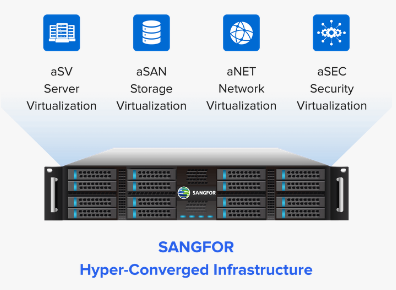
In addition to infrastructure consolidation, Sangfor HCI also includes built-in security capabilities through its aSEC security framework. This integrated security approach helps logistics organizations strengthen ransomware protection, secure east-west traffic, and improve workload protection without relying entirely on separate security layers.
Why does this matter? Well, logistics companies often need to scale up and down depending on their requirements. Legacy systems, ones that are dependant on the three-tier systems, are difficult to scale.
But when HCI powers this platform, it simply takes adding nodes to scale the platform up. It doesn’t involve any forklift upgrade or extended downtime.
For organizations reassessing VMware environments due to rising licensing costs and operational complexity, Sangfor HCI is also a practical alternative to VMware. It allows logistics companies to simplify virtualization management while maintaining scalability, performance, and operational continuity.
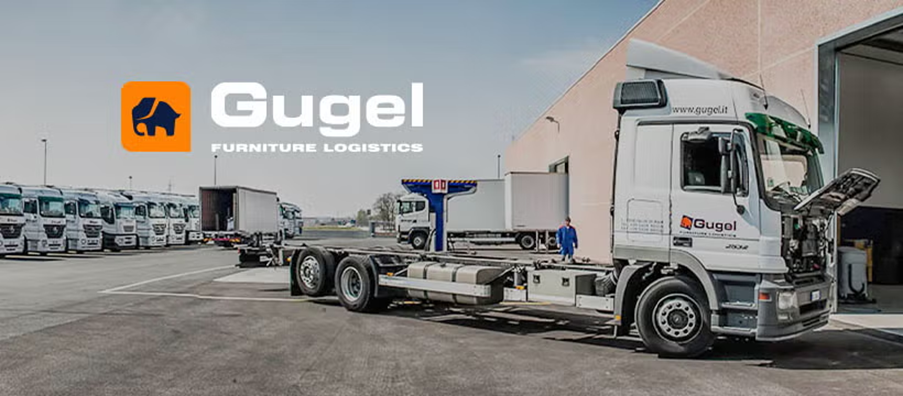
Take Gugel, an Italian logistics firm that manages a fleet of 150 trucks and a 20,000 square meter facility. They were running a VMware-based setup that had grown too complex and too rigid to manage efficiently.
But, once they migrated to Sangfor HCI, they consolidated their entire infrastructure into a single flexible, and manageable platform. This integration allowed their IT team to keep pace with operations instead of constantly firefighting issues regarding infrastructure.
That’s one of the clearest logistics infrastructure use cases for Sangfor out there: replacing brittle legacy setups with a unified platform that your team can actually manage without calling in specialists every six months.
Real Use Cases Across the Logistics Chain
Here’s where things get tangible. Let’s break down a few logistics infrastructure use cases that come up again and again:
- Fleet Management: Run GPS tracking, vehicle diagnostics, and dispatch on a low-latency, unified HCI platform, with no fragmented systems
- Warehouse Operations: Real-time inventory, scanning, and automation stay fast even during peak surges with scalable infrastructure
- Shipment Tracking: Centralized systems with branch replication ensure consistent, real-time data across all locations
- Remote Teams: Secure remote access gives field and depot teams full visibility, without compromising network security (as required by CJ Logistics)
How does digital infrastructure reduce downtime in transportation?
Sangfor HCI’s automatic failover and active/active cluster architecture ensures logistics systems stay operational even during hardware failures, protecting uptime across warehouse and fleet management platforms.
Beyond uptime, there’s the cost angle. Consolidated infrastructure cuts hardware costs, reduces power consumption, and shrinks the number of vendors you’re managing. That’s real money back into operations.
This isn’t simply marketing, the cost reduction shows in statistics with many users reporting having more than half of their IT cost reduced after adopting Sangfor. Plus, the reliability of Sangfor HCI is already visible through peer review insight platforms like G2.
Then, there’s the competitive angle: Logistics is a thin-margin industry. The companies that win are the ones who can fulfill orders faster, reroute shipments smarter, and give clients better visibility. None of that is possible without an infrastructure layer that supports it.
Choosing the Right Infrastructure Partner
The nature of an IT infrastructure is the foundation behind their real time operational efficiency. But no two partners are the same. When you’re going for the best IT infrastructure provider, know that the best tool alone isn’t enough. Your logistics business deserves a provider who understands your challenges and workloads.
That’s why, always go with providers that have already made their mark in the industry. Sangfor has done it with J&T Express, the Port of Venice and others. The pattern across those deployments is consistent: consolidate the infrastructure, secure the access layer, and give operations teams the visibility they need to actually do their jobs.
If you’re evaluating options, it’s worth seeing the platform in action. You can request a demo here to see how Sangfor HCI fits into your specific logistics environment.
Recommended Articles:
AI In Telecommunications: Keys to Building an Infrastructure
Unlock Business Growth with AI
Comments
0 comments