Last Updated on March 27, 2026 by Prabhakar A
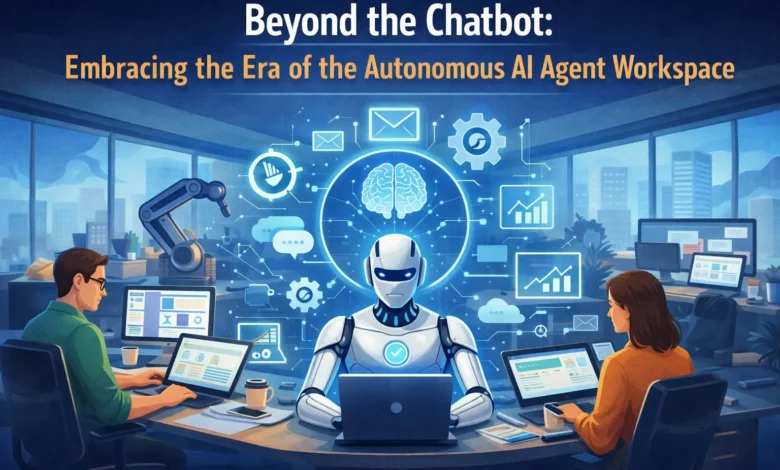
The initial shockwave of generative AI has subsided, leaving a crucial question in its wake: What comes next? For the past few years, professionals across all industries have wrestled with Large Language Models (LLMs) trapped inside passive chat interfaces. We have grown accustomed to prompting, copy-pasting, and managing the AI as if it were a temperamental junior assistant. This fragmented workflow—where the AI is a destination rather than a seamless part of the process—is the final bottleneck in the quest for true digital productivity.
The limitations are clear. Traditional AI chatbots excel at isolated tasks—summarizing a text, drafting an email, or generating an image—but they fail at executing complex, multi-step business strategies autonomously. They lack the context of a dedicated environment and the agency to act without constant human guidance. The workforce doesn’t need another chatbot; it needs a super agent capable of independent reasoning and end-to-end execution.
This is the central thesis of 2026: the future of work belongs to a unified environment that seamlessly merges raw,HIX AI – The AI Agent Workspace, into the actual flow of professional output.
Table of Contents
1. The Anatomy of an AI Agent: From Passive to Active
To understand this paradigm shift, one must differentiate between reactive AI and proactive agents. A typical reactive model waits for a prompt. It is a dictionary, a calculator, or a writer, but only on demand. It possesses intelligence, but not agency.
Conversely, an AI super agent is designed for autonomy. It doesn’t just process information; it perceives a high-level goal, breaks it down into actionable sub-tasks, plans its execution path, and performs the work.
The ‘Perceive-Plan-Act’ Loop
An autonomous agent operates on a continuous feedback loop:
- Perceive: It digests the user’s complex intent (e.g., “Build a multi-channel launch campaign for Product X”).
- Plan: It initiates a decomposition phase, identifying necessary micro-tasks (competitor research, social media copywriting, visual asset creation, asset scheduling).
- Act: It triggers its internal specialized modules—web browsers, writing engines, graphic designers—to execute each micro-task in the correct sequence.
This is not just “smart” automation; it is genius ai that can bridge the gap between human intent and finished project without a human hand-holding the AI through every iteration.
Do you know: 10 Chatbots Marketing Strategies
2. The Agent Workspace: The Missing Piece of the Productivity Puzzle
Why do even the most powerful agents fail when used through a standalone chat bubble? The answer is a lack of context and environment. An agent, much like a human employee, needs a desk, a filing cabinet, and access to the right tools to be effective. It needs an agent workspace.
Eliminating Tool Fatigue
The modern professional is plagued by tool fatigue. They research in one tab, write in a second, design in a third, and manage tasks in a fourth. Standalone AI tools only add to this fragmentation. When an AI tool is simply a side-car, the human becomes the bottleneck, constantly transferring data between the AI and the actual working document.
A dedicated agent workspace collapses these silos. It is a unified environment where the genius ai agent lives inside the working environment.
- Context Preservation: The agent has a “Brand Memory,” understanding the specific tone, guidelines, and historical data of the user, ensuring every output is contextually accurate.
- Native Interoperability: Data flows natively between sub-systems. Research synthesized by the agent directly informs the initial draft of a blog post, which then automatically triggers the generation of relevant visual assets—all within the same dashboard.
3. High-Fidelity Research and Data Synthesis
In a professional setting, accuracy is paramount. Early LLMs often hallucinated facts, leading to a profound trust gap. A super agent, however, is built for data integrity.
Fact-Based Reasoning
When tasked with a deep research objective, the agent doesn’t just rely on pre-trained weights. It accesses real-time data from the web, cross-references sources, and cites its material. This process is less like a chatbot talking and more like a high-level researcher delivering a cited report.
Deep Data Analysis
For analytical roles, the agent can ingest massive datasets (CSV, PDF), perform complex statistical correlations, and generate dynamic visualizations. Whether it is sentiment mapping a thousand customer reviews or forecasting a sales trend, the super agent provides the raw data power needed for strategic decision-making.
Also know: AI Chatbots To Boost Your Customer Service
4. Multi-Modal Execution and Content Orchestration
The 2026 content landscape is not just text. It is multi-modal, requiring high-quality written copy, visually engaging graphics, and short-form video. The power of a unified workspace is its ability to orchestrate this entire spectrum.
Authoritative Long-Form Writing
Early AI writing was often stiff and repetitive. Next-gen agents possess a linguistic nuance that adapts to local dialects and professional tones in over 50 languages. The agent can write 2,000-word SEO-optimized articles that are structured, logically consistent, and natively citations-checked—far beyond the capabilities of a generic ai writer.
Direct Visual Assets
Instead of switching to separate visual generation platforms, users can direct the agent to generate professional charts, structural diagrams, or social media graphics directly within the document flow. This ensures a visual and narrative consistency that is nearly impossible to achieve with fragmented tools.
Automated Formatting and PPT Generation
Perhaps the most significant leap in productivity is the automated formatting engine. Once the agent has completed the research and strategy phase, the genius ai can, with one click, structure the entire project into a professional, logically consistent PowerPoint presentation. This converts hours of manual formatting into a 30-second export process.
5. Security, Trust, and Enterprise Sovereignty
As corporations integrate AI deeper into their fundamental workflows, data security has become the defining concern. The risks of using standalone chatbots, where proprietary data might leak into public training sets, is a non-starter for enterprise clients.
Sandboxed Intelligence
A managed workspace provides a necessary security umbrella. Data processed within the workspace is encrypted, sandboxed, and isolated. This ensures that the user’s “Brand Memory”—their unique prompts, confidential strategies, and client data—remains proprietary. This enterprise-grade security is a core reason why professional agencies are moving away from fragmented tools toward unified, secure platforms.
6. Conclusion: Mastering the Agentic Future
The era of experimenting with AI as a novelty is over. We have entered a period where AI is the fundamental infrastructure of professional work. The most successful individuals and agencies in 2026 will not be those who can write the best prompts for separate chatbots, but those who can most effectively manage an AI workforce within a unified workspace.
The future is autonomous, fact-based, and multi-modal. By providing a “No-Setup” cloud environment that combines deep data analysis with automated execution, this next generation of workspace has effectively removed the barriers to entry for high-performance productivity.Stop managing a toolkit and start leading your workforce. Focus on the strategy, the creativity, and the high-level goals. Let your super agent handle the heavy lifting. By prioritizing structural clarity, data integrity, and multi-modal orchestration, you can scale your professional output to unprecedented heights. The future of work is not just intelligent; it is agentic.
Comments
0 comments